What colors look good on your skin tone?
Take the free undertone test for a starting palette, or use the draping mirror: pick a person, tap a color and compare how the skin reads.

Who is in the chair
Cobalt on fair, cool skin
Her skin reads lighter and more even, and her gray-blue eyes look bluer. The clearest of the four on her.
To our eyes: cobalt looks clearest on her, then lilac. Mustard looks least even.
How to read the mirror
Draping works by comparison. Hold two colors up in turn, in the same light, and ask which one your face looks better next to. These are the four things colorists look at, in plain words.
- Evenness
- With a good color, redness, shadows under the eyes and blotchy patches look quieter. With a poor one, they seem to come forward. Watch the cheeks and the area around the nose.
- Undertone
- The steady hue under your skin's surface: warm (golden, peachy), cool (pink, rosy), neutral (a mix) or olive (with a green or gray cast). Colors that share your undertone's direction tend to look calmer next to your skin.
- Depth
- How light or deep your skin is, from fair to very deep. Depth sets the contrast you can carry. It has nothing to do with undertone: deep skin can be cool, and fair skin can be warm.
- Clarity
- Whether bright, clean colors or softer, grayed ones suit you. Some faces look sharper in cobalt; others look best in dusty, muted shades.
We sampled the cheeks in all five images of each person: the skin pixels match within about six RGB levels. The face itself does not change; the try-on only adds a little color reflected from the shirt onto the neck. What changes is how your eye reads the skin next to each color, and that is what draping is meant to test.
See a garment on your own photo
The draping mirror uses three example people. To see a color, or a piece you are thinking of buying, on yourself, upload a photo of yourself and a photo or shop link of the garment. FitInView creates a try-on image of you wearing it.
Try it on your own photoCreate a free account
Your first try-on is included with a free account. No card needed. Your photos are private to your account, and you can delete them.

Find your own undertone
The mirror shows three people. For yourself, the quickest at-home check needs two towels and a window.
Stand facing daylight with no makeup, hair pulled back. Hold the bright white towel under your chin, then the cream one. If white makes your skin look clearer and cream makes it look yellowish, you probably lean cool. If cream looks softer and white looks harsh, you probably lean warm. If you honestly cannot tell, that is a useful answer too: you may be neutral.
One test is only a hint. The undertone test combines seven clues like this one, asks about your skin depth separately, and gives you a palette, neutrals and metals to match.
What the mirror shows, and what it doesn't
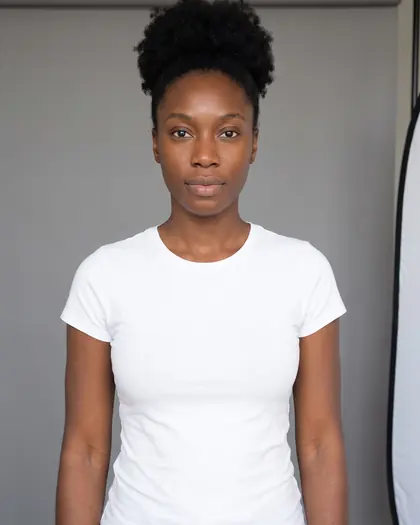
The three people are AI-generated studio portraits in a white tee, made for this site; no real person was photographed. The four colored versions of each were made with FitInView's try-on from product images of the same t-shirt in four colors. Everything else stays fixed: same face, same pose, same light.
That control is the point. In real life, your light changes from room to room and your eye adjusts. Here, almost the only thing that moves is the color under the chin, so the differences you notice come mainly from the color.
Three honest limits. These are generated images, not photos of real people. A screen is not a mirror, and your display shifts color. And these are three examples, not three rules: someone else with fair, cool skin may see something different. Use the mirror to train your eye, then try the same comparison on yourself.
Clothing colors by skin tone
Each guide gives a starting palette (by skin depth, or by undertone for dark skin), the neutrals and metals that tend to work, and the colors worth testing before you buy.
Questions about skin tone and color
What colors look good on every skin tone?
No color works equally well on everyone, but colors in the middle, neither very warm nor very cool, neither very light nor very dark, are the safest shared ground: teal, jade, a true red that is neither orange nor blue, soft white and navy. In our mirror, cobalt was among the clearest colors on all three people.
Does undertone or skin depth matter more?
They answer different questions. Depth tells you how much contrast you can wear, so it often decides light versus dark. Undertone tells you which version of a color to pick, such as coral versus raspberry. A color that gets both right usually looks best.
Can your undertone change?
Your surface tone changes with sun, redness, medication and age. Undertone is generally considered steady over adult life. A summer tan can still shift which colors look best for a few months, and gray hair can change your overall contrast.
Is olive a separate undertone?
Some systems treat olive as its own category and some fold it into neutral. In practice, olive skin reads warm-neutral with a green or gray cast, and the usual warm or cool advice tends to misfire on it. That is why it gets its own result here and its own guide.
Can I wear colors outside my palette?
Of course. A palette is a description of what tends to look easiest near your face, not a list of rules. Wear a color you find harder near your face as trousers, a skirt or shoes, or put a scarf or collar in a better color between it and your face.
How reliable are the vein and jewelry tests?
Each one alone is a rough clue. Vein color depends on lighting and skin thickness, and jewelry preference is partly taste. Several clues pointing the same way, checked in daylight, are much more reliable than any single one.